

August 4, 2023
Summary: in this tutorial, you will learn how to catch PostgreSQL exceptions in PL/pgSQL.
Table of Contents
Introduction to the PL/pgSQL Exception clause
When an error occurs in a block, PostgreSQL will abort the execution of the block and also the surrounding transaction.
To recover from the error, you can use the exception clause in the begin...end block.
The following illustrates the syntax of the exception clause:
<<label>>
declare
begin
    statements;
exception
    when condition [or condition...] then
       handle_exception;
   [when condition [or condition...] then
       handle_exception;]
   [when others then
       handle_other_exceptions;
   ]
end;
How it works.
- First, when an error occurs between the
beginandexception, PL/pgSQL stops the execution and passes the control to the exception list. - Second, PL/pgSQL searches for the first
conditionthat matches the occurring error. - Third, if there is a match, the corresponding
handle_exceptionstatements will execute. PL/pgSQL passes the control to the statement after theendkeyword. - Finally, if no match found, the error propagates out and can be caught by the
exceptionclause of the enclosing block. In case there is no enclosing block with theexceptionclause, PL/pgSQL will abort the processing.
The condition names can be no_data_found in case of a select statement return no rows or too_many_rows if the select statement returns more than one row. For a complete list of condition names on the PostgreSQL website.
It’s also possible to specify the error condition by SQLSTATE code. For example, P0002 for no_data_found and P0003 for too_many_rows.
Typically, you will catch a specific exception and handle it accordingly. To handle other exceptions rather than the one you specify on the list, you can use the when others then clause.
Handling exception examples
We’ll use the film table from the sample database for the demonstration.
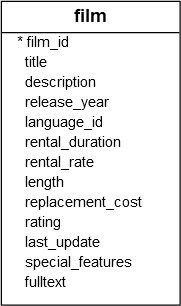
1) Handling no_data_found exception example
The following example issues an error because the film with id 2000 does not exist.
do
$$
declare
	rec record;
	v_film_id int = 2000;
begin
	-- select a film
	select film_id, title
	into strict rec
	from film
	where film_id = v_film_id;
end;
$$
language plpgsql;
Output:
ERROR:  query returned no rows
CONTEXT:  PL/pgSQL function inline_code_block line 6 at SQL statement
SQL state: P0002
The following example uses the exception clause to catch the no_data_found exception and report a more meaningful message:
do
$$
declare
	rec record;
	v_film_id int = 2000;
begin
	-- select a film
	select film_id, title
	into strict rec
	from film
	where film_id = v_film_id;
        -- catch exception
	exception
	   when no_data_found then
	      raise exception 'film % not found', v_film_id;
end;
$$
language plpgsql;
Output:
ERROR:  film 2000 not found
CONTEXT:  PL/pgSQL function inline_code_block line 14 at RAISE
SQL state: P0001
2) Handling too_many_rows exception example
The following example illustrates how to handle the too_many_rows exception:
do
$$
declare
	rec record;
begin
	-- select film
	select film_id, title
	into strict rec
	from film
	where title LIKE 'A%';

	exception
	   when too_many_rows then
	      raise exception 'Search query returns too many rows';
end;
$$
language plpgsql;
Output:
ERROR:  Search query returns too many rows
CONTEXT:  PL/pgSQL function inline_code_block line 15 at RAISE
SQL state: P0001
In this example, the too_many_rows exception occurs because the select into statement returns more than one row while it is supposed to return one row.
3) Handling multiple exceptions
The following example illustrates how to catch multiple exceptions:
do
$$
declare
	rec record;
	v_length int = 90;
begin
	-- select a film
	select film_id, title
	into strict rec
	from film
	where length = v_length;

        -- catch exception
	exception
	   when sqlstate 'P0002' then
	      raise exception 'film with length % not found', v_length;
	   when sqlstate 'P0003' then
	      raise exception 'The with length % is not unique', v_length;
end;
$$
language plpgsql;
Output:
ERROR:  The with length 90 is not unique
CONTEXT:  PL/pgSQL function inline_code_block line 17 at RAISE
SQL state: P0001
4) Handling exceptions as SQLSTATE codes
The following example is the same as the one above except that it uses the SQLSTATE codes instead of the condition names:
do
$$
declare
	rec record;
	v_length int = 30;
begin
	-- select a film
	select film_id, title
	into strict rec
	from film
	where length = v_length;

        -- catch exception
	exception
	   when sqlstate 'P0002' then
	      raise exception 'film with length % not found', v_length;
	   when sqlstate 'P0003' then
	      raise exception 'The with length % is not unique', v_length;
end;
$$
language plpgsql;
Output:
ERROR:  film with length 30 not found
CONTEXT:  PL/pgSQL function inline_code_block line 15 at RAISE
SQL state: P0001
Summary
Use the exception clause in the begin...end block to catch and handle exceptions.