

July 24, 2026
Summary: This tutorial will use a real-world “event and subscription management platform” project as a central example, to share practical design patterns and advanced features from PostgreSQL experience.
Table of Contents
Core Insights & Key Takeaways
- Look Beyond Traditional ORM & SQL-92: Don’t treat the database merely as a simple object-relational mapping (ORM) layer or limit yourself to basic SQL-92 standards. PostgreSQL comes loaded with powerful, native, advanced features.
- Leverage Native Database Capabilities: By cleverly using specialized data types, constraints, indexes, and concurrency mechanisms, you can push complex business logic down into the database layer—significantly simplifying application code and boosting system robustness.
Core Design Patterns & Technical Solutions
Pattern 1: Time Ranges & Blackout Periods (Range Types + Generated Columns)
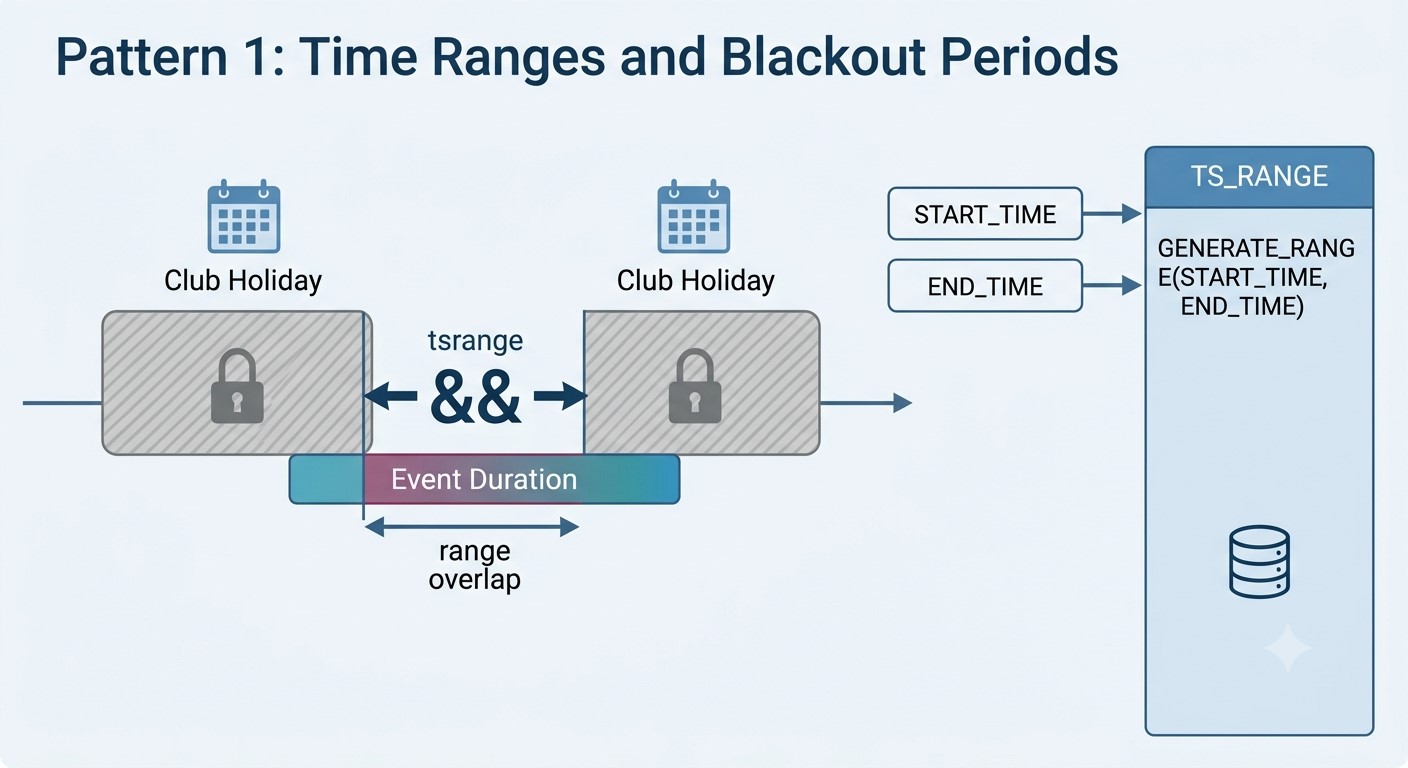
Business Scenario: Events have start and end times, and you need to check if an event overlaps with venue blackout or holiday periods (including edge cases like indefinite closures without an end date).
Technical Implementation:
- Timestamp Range Type (
tsrange): Uses PostgreSQL’s native range types to represent time intervals with lower and upper bounds. - Overlap Operator (
&&): Evaluates if two time ranges overlap (range1 && range2) directly, making the code cleaner and semantically clearer than multi-condition comparison logic. - Generated Columns: Computes and stores the timestamp range column automatically from
start_timeandend_timeat the database level, sparing the application layer from parsing complex string representations.
Pattern 2: Preventing Double Booking (Exclusion Constraints + GiST Index)
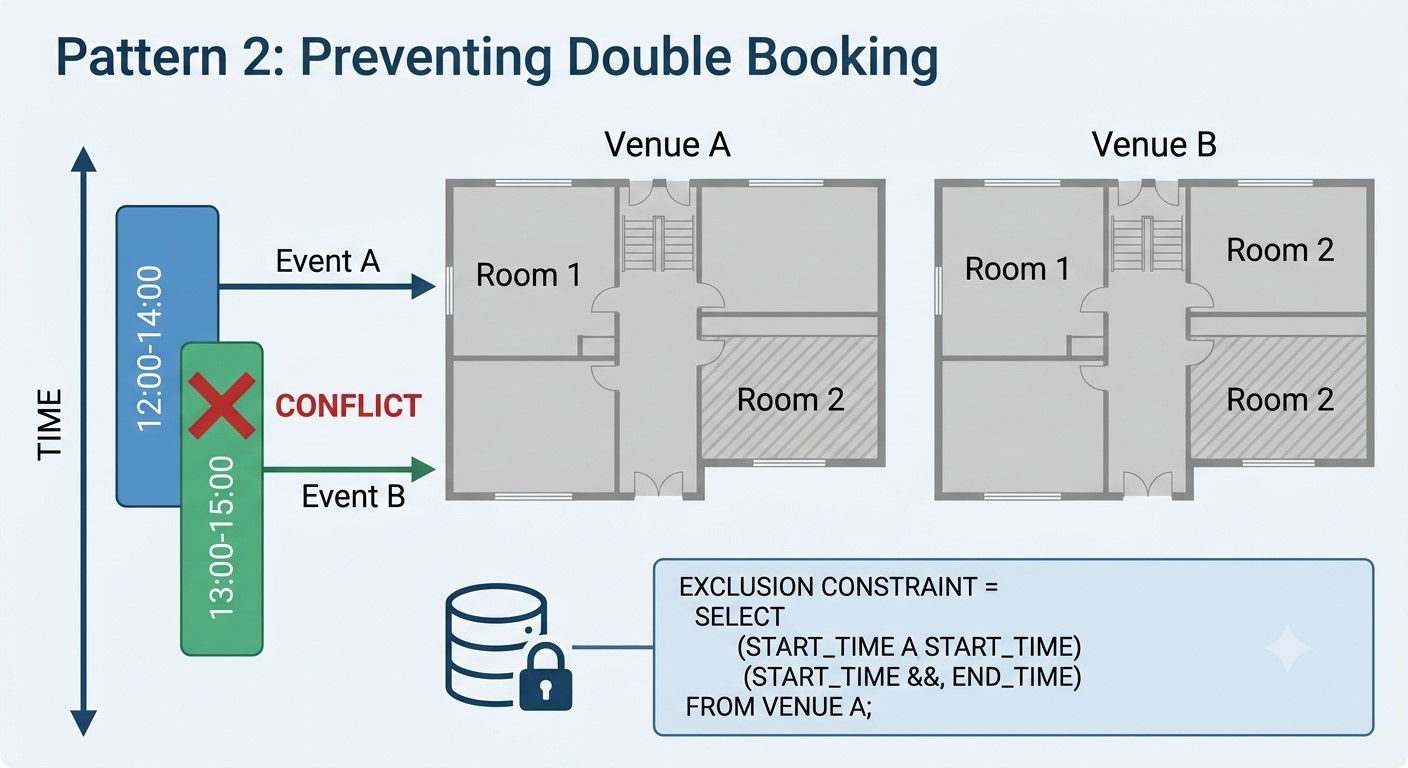
Business Scenario: A physical venue cannot host two conflicting events at the same time, preventing double-booking caused by concurrency issues.
Technical Implementation:
- Exclusion Constraints: Ensures that no two rows in a table satisfy a specified set of condition comparisons simultaneously.
- Extension Support (
btree_gist): Uses a core PostgreSQL extension to enable B-tree support inside GiST indexes for scalar equality operators (e.g., venue ID). - Constraint Combination: Combines the equality condition (
=) on venue ID with the overlap condition (&&) on time ranges. If conflicting data is inserted or updated, the database immediately throws an error to block it.
Pattern 3: Age Range Filtering & Privacy Protection (Int4 Range Types)
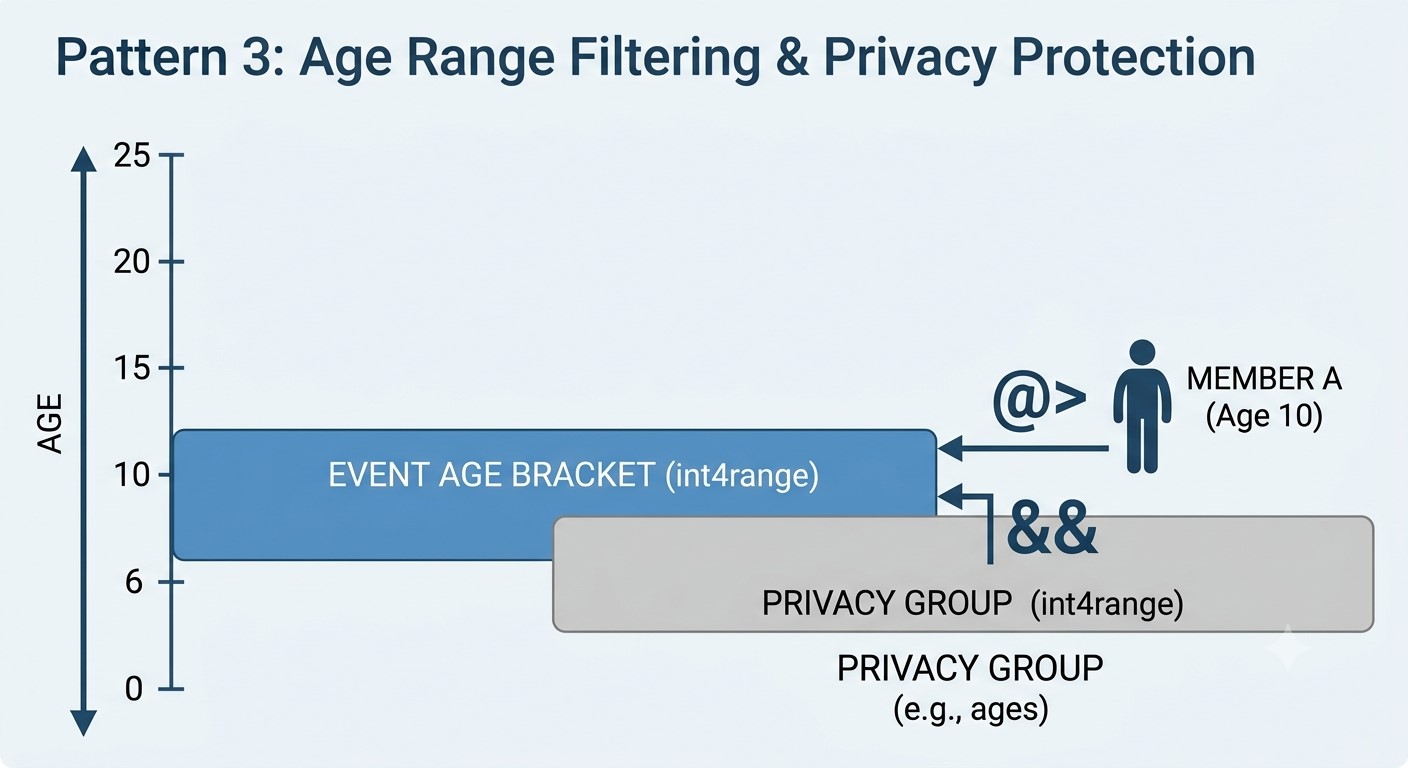
Business Scenario: Events target specific age brackets (e.g., ages 6–12) while complying with regulations like GDPR by avoiding storing children’s exact ages.
Technical Implementation:
- Integer Range Type (
int4range): Stores target age brackets as integer ranges. - Contains / Overlap Matching:
- Uses the contains operator (
@>) to query whether a specific age falls within an event’s age range. - Uses the overlap operator (
&&) to match a member’s “age bucket” with event age ranges, balancing functionality with privacy protection.
Pattern 4: Multi-Attribute & Dynamic Condition Filtering (Text Array + JSONB + GIN Index)
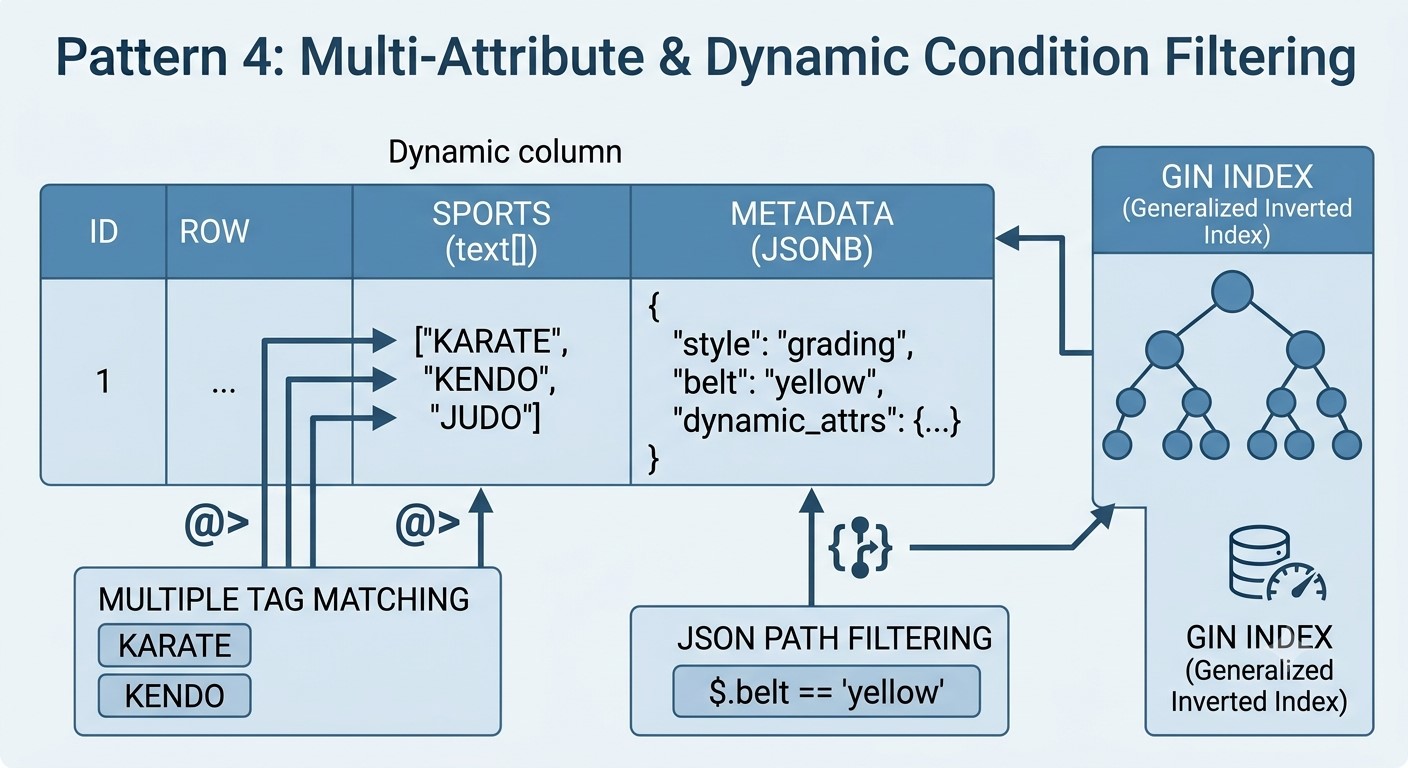
Business Scenario: An event might cover multiple sports (e.g., Karate, Kendo) or include custom dynamic properties defined by administrators (e.g., event styles, belt rank requirements).
Technical Implementation:
- Text Array (
text[]): Replaces cumbersome relational junction tables by storing tags in array columns. Using the contains operator (@>) provides built-inANDmatching for free across multiple tags. - JSONB Data Type: Stores unstructured or dynamic metadata using
jsonband leverages JSON Path expressions for complex multi-attribute filtering (e.g., matching a grading event suitable for yellow belts). - GIN Index Acceleration: Builds Generalized Inverted Indexes (GIN) on array and JSONB columns to accelerate multi-dimensional filter performance.
Pattern 5: Geospatial Search & Multi-Dimensional Queries (PostGIS + Spatial Index)
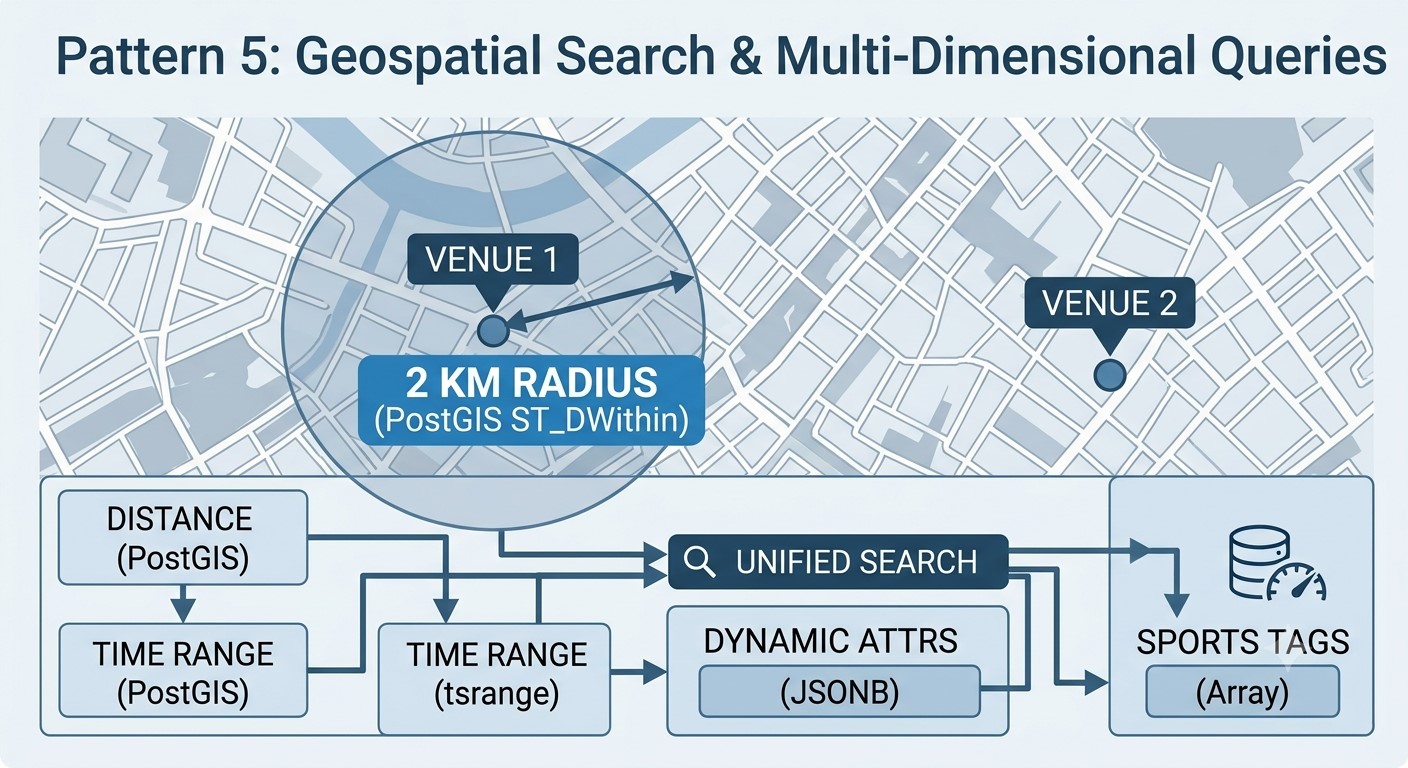
Business Scenario: Finding venues and events within a certain distance from a user’s latitude and longitude coordinates.
Technical Implementation:
- PostGIS Extension: Provides full Geographic Information System (GIS) capabilities to PostgreSQL, storing location coordinates using the
geometrytype (Point). - Spatial Reference System (SRID 4326): Uses the standard GPS coordinate system (WGS 84).
- Distance Matching (
ST_DWithin): Matches venues within a specified distance/arc degree (e.g., roughly 2 km) using PostGIS functions, accelerated by spatial indexing. - Unifying Data Types: Combines time ranges, geographic distance, sport tags (arrays), and event metadata (JSONB) into a single SQL query, highlighting PostgreSQL’s ability to unify distinct data capabilities.
Pattern 6: Single Active Subscription Guard (Partial Unique Index)
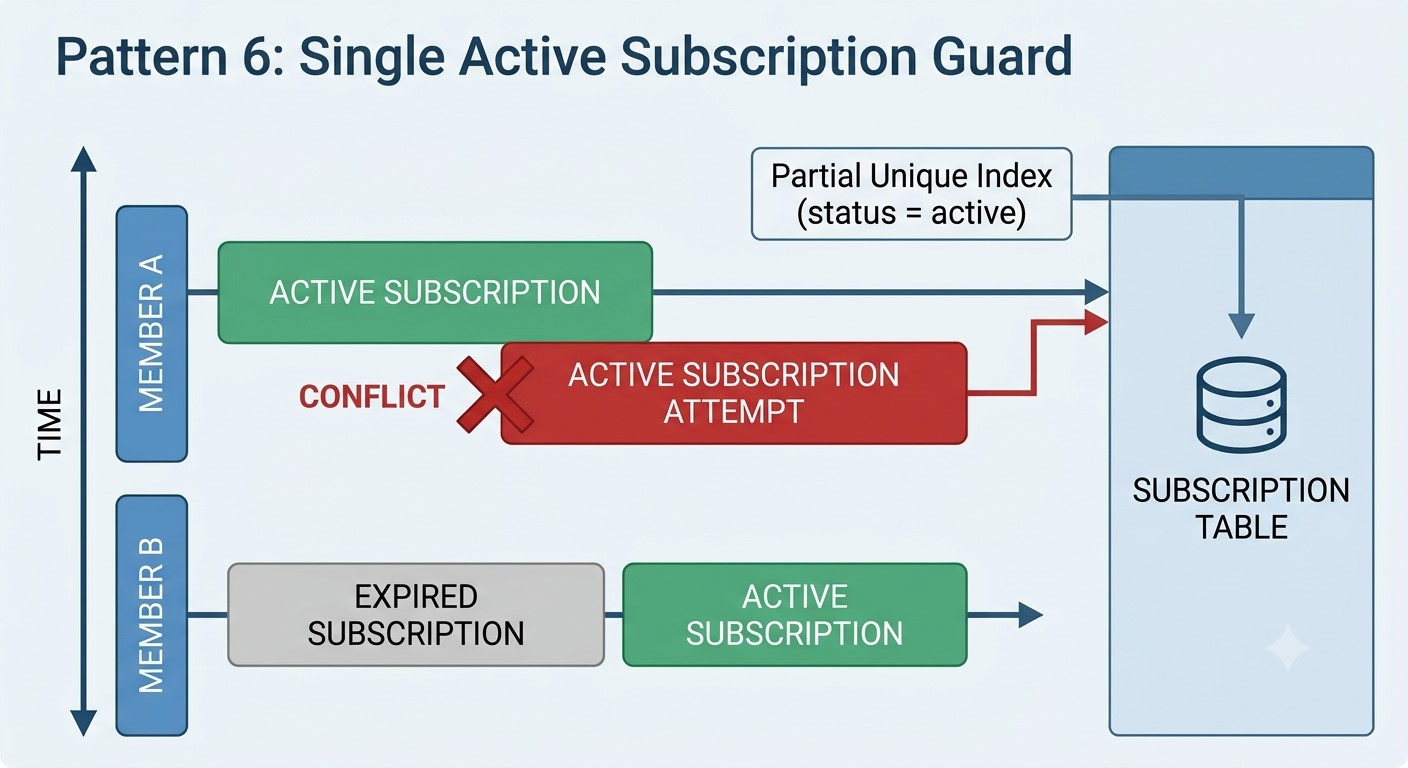
Business Scenario: A member can only have one “active” subscription at any given time to prevent accidental double-billing.
Technical Implementation:
- Partial Unique Index: Creates a unique index on the subscription table with a conditional predicate (e.g.,
WHERE status = 'active'). - Effect: The database enforces uniqueness only on active records. It preserves historical expired or canceled subscriptions while systematically eliminating concurrent double-activation issues.
Pattern 7: Database-Backed Parallel Task Queue (FOR UPDATE SKIP LOCKED + Idempotency)
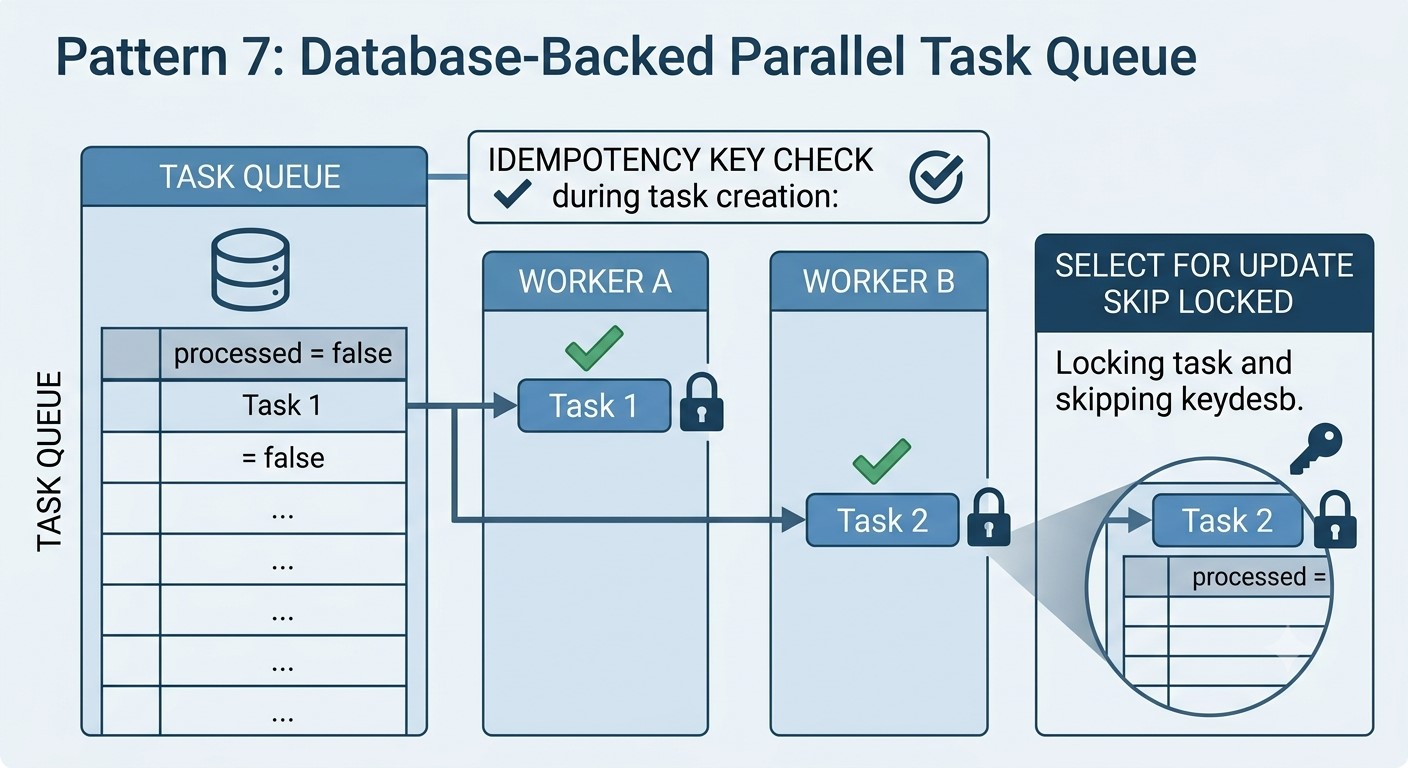
Business Scenario: Automating background payment processing and recurring renewal scheduling without introducing external message queue infrastructure (such as RabbitMQ or Redis).
Technical Implementation & Workflow:
1. Task Table Structure: Stores execution time (execute_after), processing status (processed), retry counts (retries), and JSON task payloads.
2. Parallel-Safe Consumption: Selects tasks within a transaction using:
SELECT * FROM tasks
WHERE processed = false AND execute_after <= NOW()
LIMIT 1
FOR UPDATE SKIP LOCKED;
FOR UPDATE: Locks the target row for processing.SKIP LOCKED: Skips rows currently locked by other concurrent workers, achieving lock-free parallel execution.
3. Partial Index Optimization: Uses a partial index (WHERE processed = false) to keep queue lookups extremely fast.
4. Idempotency Control (ON CONFLICT):
- Assigns a unique idempotency key to recurring tasks (e.g., monthly renewals).
- Uses
ON CONFLICT (idempotency_key) DO NOTHINGon insertion to prevent duplicate task creation seamlessly.
Summary & Recommendations
- Synergy Across Features: PostgreSQL’s true strength lies in seamlessly uniting geospatial data, JSON/arrays, time ranges, and concurrency primitives within a single database system.
- Architectural Simplification: For many small-to-medium-scale applications, leveraging PostgreSQL’s advanced native features and extensions drastically reduces reliance on external systems (e.g., dedicated search engines, message queues), reducing system complexity and maintenance costs.