

By John Doe January 5, 2026
Summary: Ultimately, a database is a production tool in the IT industry. Deciding which tool to adopt comes down to production efficiency.
Table of Contents
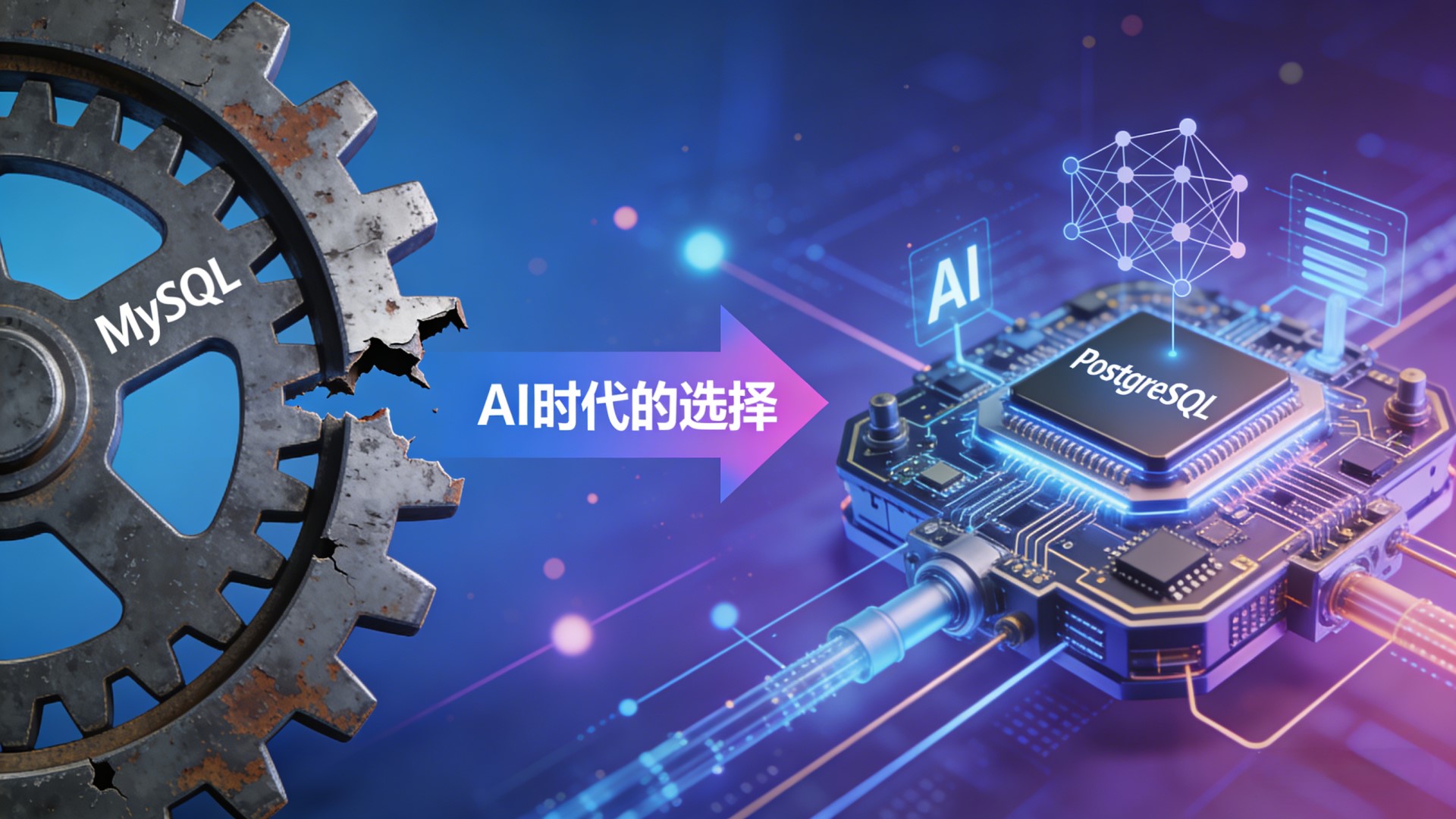
From the Internet Era (Web 2.0) to the AI Era, the ecological position of databases has undergone a fundamental shift, leading developers to gradually switch their preference from MySQL to Postgres.
In the Internet Era, the core demands were high concurrency and simple CRUD (Create, Read, Update, Delete) operations. MySQL reigned supreme thanks to its simplicity, extreme read/write performance, and the ease of the LAMP stack.
However, in the AI Era, the core demands have shifted towards developer interaction experiences oriented around AI, complex logical reasoning, and deep integration with Large Language Models (LLMs). This transition has drastically changed the way developers program.
Data Processing & Analysis: AI-Assisted Natural Language Interaction
MySQL: The optimizer favors simple OLTP (Online Transaction Processing) queries. Performance can be unpredictable when facing relatively complex nested queries (subqueries), CTEs (Common Table Expressions), or window functions.
Postgres: It possesses a powerful query optimizer and executor, with support for complex SQL that adheres strictly to SQL standards.
The Change in Programming Style:
Now, when using development tools, developers often integrate LLMs (such as Microsoft’s VS Code for PostgreSQL) to assist in writing queries intelligently.
1. User Prompt: “Find the top 10% of users with the fastest consumption growth over the past three months and analyze their main purchase categories.”
2. AI Generation: The AI generates a 60-line SQL code block containing WITH clauses (CTEs), the RANK() window function, and multi-table JOINs.
3. Execution: Postgres can execute this complex, AI-generated code stably and efficiently, whereas MySQL might time out due to a poor execution plan.
Because Postgres supports richer SQL features and has stronger logical expression capabilities, AI-generated SQL for Postgres tends to have a higher accuracy rate than for MySQL.
Additionally, leveraging Postgres’s extensibility, developers can use pg_duckdb to integrate DuckDB’s analytical capabilities, or pg_clickhouse to integrate ClickHouse’s power for analyzing massive datasets.
From “Processing Logic in App Layer” to “Pushing Logic Down to DB”
In the MySQL era, to relieve database pressure, developers followed the principle of “Database as Storage Only.” Complex business logic was usually handled in the Java/Python application layer, while the database only ran simple SELECT * FROM table WHERE id = ? queries.
The AI Era Programming Change:
AI applications (especially Agents and RAG) often need to process massive amounts of context, making data transfer costs extremely high. Postgres’s powerful computational capability allows developers to push logic down to the database.
MySQL’s Pain Point: Stored procedure syntax is obscure, debugging is difficult, and performance optimization is limited, causing developers to avoid them.
Postgres’s Advantage:
- Powerful PL/PgSQL: Supports complex control flows and exception handling.
- AI Empowerment: Previously, developers didn’t write stored procedures because they were “hard to write.” Now, through natural language (e.g., ChatGPT/Claude), a developer can say: “Please help me write a PL/PgSQL function to calculate user retention and apply weighted scoring.” High-quality stored procedures generated by AI directly utilize Postgres’s computing power, making “Database as Backend” possible.
Paradigm Shift: Moving from “Application Layer Business Logic” to “In-Database Computational Logic.” Leveraging AI-generated complex SQL and stored procedures significantly simplifies the intermediate layer code.
Vector Programming: From Keyword Matching to Semantic Search
This is the most significant feature of the AI era. The core of AI applications is Vector Embeddings.
MySQL’s Dilemma: MySQL’s support for vector search started late, and its ecosystem is relatively closed.
Postgres’s pgvector: Through its plugin mechanism, Postgres has transformed into the most popular vector database.
The Change in Programming Style:
Past (Keywords): Developers wrote LIKE '%apple%'.
Present (Semantics): Developers convert text into vectors, store them in the Postgres vector field, and then use natural language to perform similarity queries.
Developers do not need to introduce a new specialized vector database (like Milvus) to increase architectural complexity; they simply install a plugin on the existing Postgres instance. This means developers can query both relational data (tuples) and semantic data (similar documents) within the same SQL transaction.
-- Typical Typical PG-style vectorized query: Hybrid Search
SELECT document_text
FROM documents
WHERE user_id = 123  -- Relational Filtering
ORDER BY embedding <=> '[0.1, 0.3, ...]' -- Vector Semantic Sorting
LIMIT 5;
Extensibility: The “Operating System” of the Database World
The design philosophy of Postgres is that everything is extensible.
MySQL: It is a simple, focused database. If you want to add a new data type or processing method, you usually need to integrate a new specialized database.
Postgres: It provides extension interfaces and Foreign Data Wrappers (FDW), serving as an abstract framework for data management in the AI era.
The Change in Programming Style:
In many internet projects, the early stage requires agile iteration and quick launches, so MySQL is used. Later, if fast content retrieval is needed, ElasticSearch is added. When big data analysis is required, Hadoop is set up.
Switching to Postgres: If you need full-text search and hybrid search, you can use ParadeDB; if you need data analysis, you can use pg_duckdb or pg_clickhouse; for AI vector search, you can use pgvector.
Developers don’t need to integrate new specialized databases for new features; they just need to run CREATE EXTENSION. This “LEGO-like” programming experience makes Postgres the “Universal Glue” in the AI tech stack. Developers only need to know how to use AI to correctly convert natural language into Postgres SQL syntax to complete various complex data processing logic.
This unifies the SQL syntax for all data processing tools, eliminating the problems centered around MySQL such as “numerous SQL dialects,” “data silos,” and “complex operations.” Using AI to convert natural language into Postgres SQL syntax refactors all data processing logic, significantly boosting IT R&D productivity and upgrading the intelligent interaction experience of IT applications.
Summary Comparison Table
| Dimension | Internet Era (MySQL Paradigm) | AI Era (Postgres Paradigm) |
|---|---|---|
| Core Data | Structured Text / Numbers | Vectors, JSON, Unstructured Data |
| Logic Location | Java/Python App Layer handles logic | Logic pushed down to DB (Complex SQL/Stored Proc) |
| Code Generation | Hand-written SQL, kept simple | AI-generated Complex SQL / Stored Procedures |
| Query Mode | Exact PK Match (Where ID=1) |
Semantic Search + Hybrid Query |
| Data Management Style | Simple & Focused + Multiple specialized DBs | Feature-rich + Extensions for specialized processing |
| Dev Experience | Manual dev, requires specialized skills | AI-oriented natural language interaction, focus on business intent |
Conclusion
The reason Postgres has become the preferred choice in the AI era is that it is no longer just a “warehouse for storing data,” but has evolved into an “AI-oriented data processing platform.”
With the support of AI-assisted programming, Postgres’s complex features (such as stored procedures and complex queries) are no longer a burden for developers. Instead, they have become powerful weapons, perfectly adapting to the needs of AI applications for local data computation and multi-model data processing.